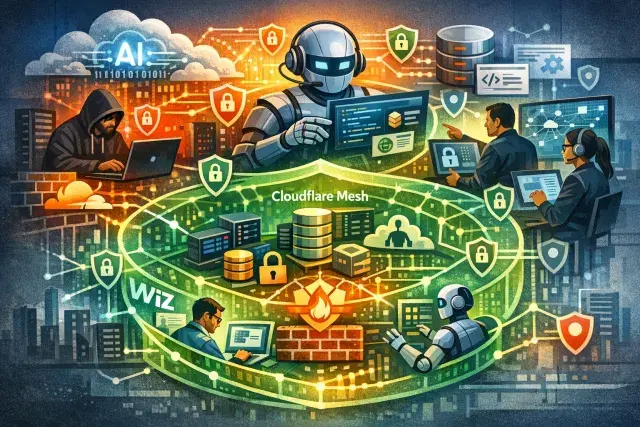

AI agents are starting to act less like simple software tools and more like workers inside corporate systems, with access to code repositories, databases, internal applications, and testing environments. That shift is creating a security problem: the more useful these agents become, the more authority they often need, and poorly managed access can expose private infrastructure or sensitive data.
Cloudflare is responding with Cloudflare Mesh, a private networking layer designed to connect AI agents, employees, and internal systems across cloud and on-premise environments without exposing services to the public internet. The company is also expanding its partnership with Wiz to give security teams better visibility into where AI systems are running and what data they can reach.
Why AI agents create a different security challenge
Traditional enterprise security was built around human users. A person logs in, opens a VPN, and reaches a limited set of systems. AI agents do not fit that model neatly. They may run continuously, call multiple services in sequence, and move across development, testing, and production environments as part of routine workflows.
That changes the risk profile. If an agent is given broad network access for convenience, it can become a path into systems that were never meant to be broadly reachable. If internal tools are exposed to simplify connectivity, the attack surface expands. And if security teams do not know which agents exist or what they can access, oversight breaks down before any breach occurs.
This is one reason identity is becoming as important as network location. Treating each agent as a distinct identity, with narrowly defined permissions, reflects a wider move in enterprise security away from perimeter-based trust and toward policies tied to specific workloads, users, and services.
What Cloudflare Mesh is trying to solve
Cloudflare’s pitch is straightforward: developers should not have to choose between slow, manual private networking and the risk of making internal services internet-facing. Mesh creates a private network layer where traffic using private IP addresses stays encrypted on Cloudflare’s network, while access rules can be defined in code through products such as Workers, Workers VPC, and the Agents SDK.
That matters because AI systems are often assembled from many parts. An agent may need to query an internal knowledge base, write to a testing service, read logs, and call tools hosted in different clouds. In many companies, stitching those connections together still involves separate VPNs, custom routing, or one-off exceptions. A unified control layer could reduce the operational friction that leads developers to take shortcuts.
The finer point is not just connectivity but constraint. One agent might be allowed to inspect a staging database and nothing else. Another could reach a customer support system but be blocked from financial records. For security teams, that kind of segmentation is more useful than broad network access wrapped in a single login.
Visibility remains the harder problem
Access control only solves part of the issue. Many organizations still lack a reliable inventory of AI systems operating inside their environment, particularly when tools are introduced by individual departments or developers without formal review. That is the problem often described as shadow AI: systems handling internal data or business logic without clear governance.
The Cloudflare-Wiz integration is aimed at that visibility gap. Cloudflare says its AI Security for Apps inspects requests to AI systems for prompt injection attempts, possible exposure of personal data, and restricted or unsafe interactions. Wiz, which maps relationships between cloud assets and data stores, adds context about where AI applications are deployed and what they touch.
Together, those capabilities could help security teams answer more practical questions: which AI endpoints can reach sensitive systems, where controls are missing, and which risks deserve immediate attention. For companies running workloads across multiple providers, that cross-environment view is increasingly important because AI deployments rarely stay within a single infrastructure boundary.
What this signals for enterprise security
Cloudflare’s announcement reflects a broader reality in enterprise technology. AI adoption is no longer limited to experimental pilots. As agents are woven into software development, operations, and internal support work, security architecture has to adapt from protecting human access to governing machine-driven access at scale.
The likely direction is clearer policy, narrower permissions, and better monitoring of how AI systems interact with internal data. Tools like Mesh will not remove the underlying risk; they make it more manageable if companies define strict rules and keep oversight current. The larger lesson is that AI deployment is becoming inseparable from network design, identity management, and data governance. For security leaders, that moves AI from an innovation discussion into the center of infrastructure control.