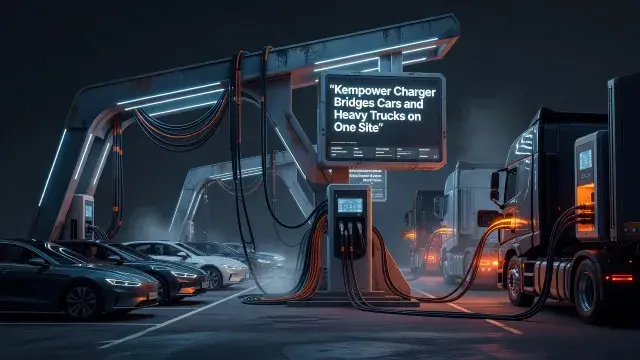
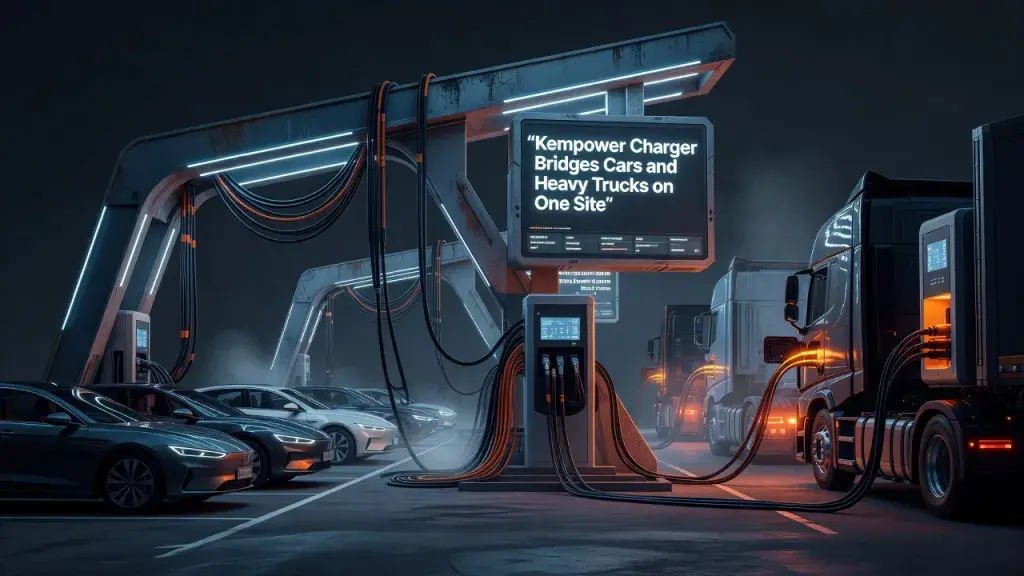
Kempower has introduced the Mega Satellite Flex, a charging unit built to serve both passenger EVs and heavy-duty trucks from a single piece of hardware. The Finnish charging manufacturer unveiled the product this week at ACT Expo during its Unplug & Recharge event for customers and partners. It marks the company's first dispenser capable of switching between the established CCS standard and the emerging Megawatt Charging System, a distinction that speaks directly to where the electric vehicle infrastructure market currently stands.
The timing reflects a real fork in the road for charging technology. CCS, or Combined Charging System, has been the dominant connector for electric cars in North America and Europe for years, handling power levels that suit sedans, crossovers, and light commercial vehicles. Heavy trucks are a different problem entirely: their battery packs are far larger, and delivery schedules leave little room for lengthy stops. That's the gap MCS is meant to close, pushing power delivery up toward the megawatt range so a semi truck can recharge in a timeframe closer to a fuel stop than an overnight pause. Just as drivers researching unfamiliar networks might look into a VPN with a free trial before committing to a subscription, fleet operators are being given a way to test high-power charging infrastructure without locking themselves into a single, inflexible system. a VPN with a free trial
By combining both protocols in one unit, Kempower is addressing a cost and planning problem that has quietly worried site developers. Building separate infrastructure for cars and trucks means duplicated permitting, duplicated grid connections, and duplicated construction. A dual-protocol charger lets a site operator serve both vehicle classes from day one and adapt as truck traffic grows, without ripping out equipment or expanding the footprint later.
What the Specifications Reveal
The technical numbers point to a unit designed for headroom rather than immediate necessity. The Mega Satellite Flex supports up to 700 amps on CCS and 1,500 amps on MCS, translating to a maximum of 560 kW for cars and 1.2 MW for trucks. Cable lengths differ by design intent: 5 meters for CCS, suited to the varied port placements on passenger vehicles, and a shorter 2.7 meters for MCS, reflecting the more standardized connector position on truck cabs. The unit can also include an integrated payment terminal, a detail that matters for public sites serving occasional commercial customers rather than fleet accounts with existing billing arrangements.
Support for 800-volt vehicle architectures is a forward-looking addition. Newer EV platforms built around 800-volt systems can accept substantially faster charging than older 400-volt designs, provided the charger and cabling can handle the higher voltage. Including that capability now means the hardware won't become outdated as more automakers shift toward 800-volt platforms in the coming years.
Compatibility and Rollout
Kempower says the new charger works with its existing distributed charging architecture, meaning operators who have already installed Kempower satellite units and power modules can add Mega Satellite Flex without reworking their entire site. That kind of backward compatibility tends to matter more to procurement teams than headline power figures, since it directly affects installation cost and downtime during upgrades.
- Up to 560 kW via CCS, up to 700 amps
- Up to 1.2 MW via MCS, up to 1,500 amps
- CCS cable length: 5 meters (16.4 feet)
- MCS cable length: 2.7 meters (8.86 feet)
- Optional integrated payment terminal
- Compatible with Kempower's existing distributed systems
The Mega Satellite Flex is scheduled to reach North America and Europe in July 2026. That gives site developers over a year to plan installations around a product still finalizing certification and manufacturing timelines. Whether it becomes a standard fixture at truck stops and mixed-use charging hubs will depend largely on how quickly the MCS standard itself matures, since a charger is only as useful as the number of vehicles built to plug into it.